Insights · Small business & hospitality
We Saw This Coming
David Lee argues unemployment at a near five-year high was predictable: wage rises kept coming without the policies to lift productivity and support business.

By David Lee21 October 2026 · 3 min read

Unemployment has just hit its highest level in nearly five years. Small business owners have been warning about this for years, and nobody in Canberra was listening.
The numbers
The Australian Bureau of Statistics reported last week that the unemployment rate rose to 4.7% in September. That is the highest since October 2021. Employment fell by 39,300 people in a single month, and 732,000 Australians are now out of work.
4.7%.
This didn’t come out of nowhere. Ask anyone running a café, a kitchen, a shop or a trade business and they’ll tell you they saw it coming.
Only one end of the equation
Every year the wage decision comes down, and every year the focus is on one thing: lifting wages. Award wages went up 3.5% in July 2025 and another 4.75% in July 2026.
I’m not against people being paid properly. Good staff are the business. But a wage is paid out of what a business earns, and nobody has done anything to help businesses earn more.
Every time wages went up, there should have been something alongside it to grow the business environment and carry that increase. A productivity measure. A policy that helps a business do more with the people it has. Instead we got the cost and none of the support.
Productivity went nowhere
Even the Fair Work Commission said it. In its 2025 decision it wrote that Australia’s “continuing poor performance in labour productivity growth” held back the size of the increase.
The latest national accounts show output per hour worked fell 0.2% in the year to June 2026. So wages keep rising and productivity doesn’t. Something has to give, and what gives is jobs.
When costs rise and income doesn’t, a small business owner has three choices: put prices up, cut hours, or stop hiring. Most of us have done all three. Multiply that across every small business in the country and you get the number the ABS published last week.
A few suggestions
A wage rise needs a plan to pay for it. Here are a few ideas that could sit alongside every wage decision.
- A tax break for productivity spending. When wages go up, give small business an extra deduction for the equipment, software and training that help each person produce more. We’ve had versions of this before: the technology investment boost ended in June 2023 and the skills and training boost in June 2024. The wage rises were permanent. The support wasn’t.
- A pay rise matched by a skills rise. Fund short, practical courses through TAFE for people already in the job, free to small business. In a kitchen that’s multi-skilling, prep and production methods, costing and food safety. The worker earns more and can do more, and the business can afford it.
- Cut the cost of employing. Make the awards simpler to roster and pay correctly, and cut the compliance paperwork. If wages go up, the hidden costs of employing someone should come down.
Lift productivity and higher wages pay for themselves. Lift wages on their own and you end up exactly where we are now.
Small business has been saying this for years. It’s time the government started listening.
If this is hitting your business, I work with hospitality owners on costs.
Sources
- Labour Force, Australia, September 2026, Australian Bureau of Statistics, 15 October 2026
- Labour Force series: unemployment rate, seasonally adjusted, Australian Bureau of Statistics, accessed 20 October 2026
- Annual Wage Review 2025: announcement of decision, Fair Work Commission, June 2025
- Annual Wage Review 2026: announcement of decision, Fair Work Commission, 2 June 2026
- Australian National Accounts: National Income, Expenditure and Product, June 2026, Australian Bureau of Statistics, 2 September 2026
- Small business technology investment boost, Australian Taxation Office
- Small business skills and training boost, Australian Taxation Office
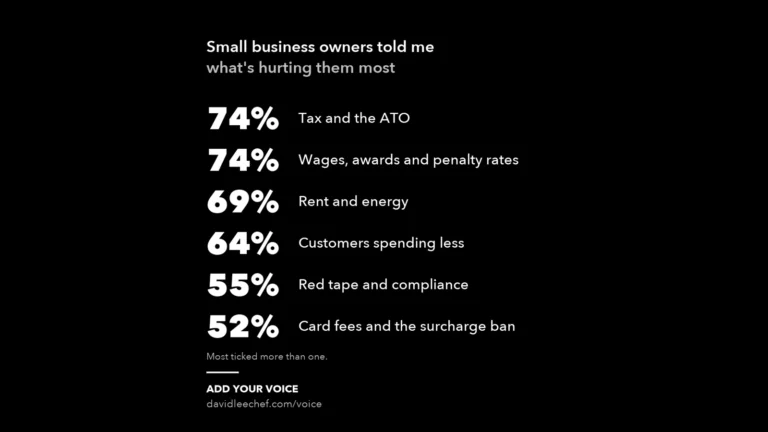
Add your voice
What’s hurting your business?
Tell me, and I’ll take it into my next interview.
More insights
22 November 2026
Are You Listening? What Small Business Owners Told Me

19 November 2026
Unemployment at 4.9%: This Isn’t Just a Cycle

18 November 2026