Insights · Small business & hospitality
Deadweight Loss: The Hidden Cost of Shrinking Businesses
David Lee argues that when tax and mandated costs make growth unprofitable, businesses stay small, and the jobs, wages and tax they would have created never exist.

By David Lee8 November 2026 · 2 min read
If you look up “deadweight loss” in an economics textbook, you’ll find neat supply and demand graphs with shaded triangles. Economists use it to describe value that’s lost when tax and regulation distort a market. Nobody gains it. Not the business, not the workers, not the government. It simply never exists.
But if you want to see what deadweight loss looks like in 2026, don’t look at a textbook. Look at the businesses quietly choosing to stay small.
Business owners are caught in a pincer. On one side is tax, from GST and PAYG to company tax. On the other are rising mandated costs, including award wage increases and compulsory super, now at 12%. With sticky inflation and high interest rates in the background, the maths of growth stops working.
So owners make a rational choice. They stop expanding.
I know, because I did it. A couple of years ago, we had a solid plan to grow, with three production kitchens and a much bigger team. Instead, we deliberately scaled back.
Over ten years, here’s roughly what that decision costs:
- About $24 million in economic activity that won’t happen
- About $10 million in wages and contracts that won’t be paid
- About $4 to $5 million in GST, PAYG and company tax that won’t be collected
- About $900,000 in super that won’t reach workers’ accounts
To be fair, part of that pullback was me reading a downturn coming. But a large share was simply that growing no longer paid. That share is deadweight loss.
People tell me I’m whinging, or that I failed as a business person. I didn’t fail. I made the sensible call, and the cost landed on everyone else: the workers who were never hired, the suppliers who were never paid and the tax base that never grew.
That’s one small business. The real question is how many others are quietly doing the same.
Sources
- The final SG rate increase is coming on 1 July, Australian Taxation Office, 2025
Add your voice
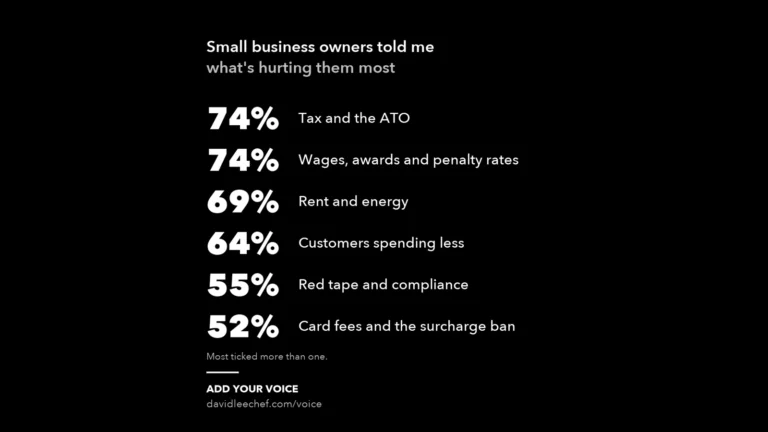
What’s hurting your business?
Tell me, and I’ll take it into my next interview.
More insights
22 November 2026
Are You Listening? What Small Business Owners Told Me

19 November 2026
Unemployment at 4.9%: This Isn’t Just a Cycle

18 November 2026